
In an institution like the military, where soldiers must die, platitudes must die as well. Horace’s famous words, “Dulce et decorum est, pro patria mori” (How sweet and fitting it is to die for one’s country), grind to a halt before real suffering:
If you could hear, at every jolt, the blood
Come gargling from the froth-corrupted lungs,
Obscene as cancer, bitter as the cud
Of vile, incurable sores on innocent tongues,—
My friend, you would not tell with such high zest
To children ardent for some desperate glory,
The old Lie: Dulce et decorum est
Pro patria mori.
The realism inherent to such work often leads to more penetrating glances, not just at the world, but to the present culture and its blind spots. This is especially helpful in an age when the tried-and-true syllogisms of twentieth-century apologetics fall flat. What then can we learn from the military milieu that will help us to take every thought captive?
The Reemergence of Spirituality
Contrary to the claims of those who thought religion and spirituality to be a dead letter, spirituality is on the rise—claiming victims from atheism, Christianity, and everything in between. Some holdovers from the moral majority era might see this as an unmitigated good (we have more in common with someone who believes in a higher power than not, after all). Others may assume the sky is falling when they consider that, in loosening the theological bonds that once knit communities together, “spirituality” is often just shoe polish for a nihilistic narcissism.
There is one evident gain that Christians should take advantage of, however. In gaining a cultural consensus, spirituality now takes pride of place in how Christians engage the culture. The Army chaplaincy, for example, has quickly built upon the work of Dr. Lisa Miller, a professor of clinical psychology at Columbia University. With countless peer-reviewed studies, she has shown that every person is born with a “spiritual core” that reaches upward and outward and can be developed, wounded, and healed.
There is much that Christians could add to this discussion from Romans 1 and 2, but we would be jumping the gun. First, we need to show why the concept of a spiritual core is helpful. As psychologists and sociologists speak of an “epidemic of loneliness” in our culture, they generally describe loneliness as the lack of vertical and horizontal bonds that give rise to meaning, purpose, and identity.
Consequently, if we are made to connect vertically with God or a higher power, and horizontally with our fellow man, but are not doing so, then we have a problem. This concept of a spiritual core provides the principle; the epidemic of loneliness presents the need—in both the military and the wider culture.
To address this need, the Army has committed an entire chapter to “spiritual readiness” in their field manual on holistic fitness. Of course, in formulating a doctrinal approach to spiritual readiness, the document—due to pluralism concerns—remains remarkably averse to any theological doctrine that may provide such readiness. But the point is not that the shot falls short of the target, but rather that the Army is taking a shot at all.
Spirituality no longer stands on one side of the culture divide. It is the deepest part of a person and arguably the most determinative factor in mental health. And, across disciplines, we are seeing that it is not effectively engaged. Thus, it stands as a key connection point between the believer and unbeliever. What is happening at the core level in each of our hearts? What was this core made for? How has it been shaped? Conversational doors open at each of these questions.
Spirituality is not only a present concern of the Army. In most Army writings concerning Large Scale Combat Operations (LSCO)—future wars against major powers—there is constant mention of the indispensability of “spiritual resiliency” in our soldiers. While the term is not formally defined, the context makes the implication clear: We need soldiers who are able to undergo and ascribe meaning to suffering. They need a belief system—a religion—that makes sense of suffering and enables them to endure. Suffering—and the prospect of suffering—brings the topic of spirituality to the fore.
The Ever-Present Problem of Suffering
Conversations about spirituality could be stiff-armed away (and often are in our culture of distraction), if not for the ever-present problem of suffering. We live in an age of distraction, where most people find enduring and intoxicating ways to cope and avoid the problem of suffering. Yet, the universal nature of suffering means that reality will come knocking at the door of distraction unbidden.
In the military, service-members must reckon with this pernicious problem on a more regular basis. They must be prepared to take life or give it, suffer in myriad ways, and then come home healthy and whole. A key marker of spiritual readiness is resiliency—a term that implies the existence of external pressure, stress, or suffering—and the ability to persevere.
But how is a soldier—or any person for that matter—able to persevere in and through suffering? Sadly, many don’t—at least not well. This is where two other terms that are growing in prominence within the military are important: “moral injury” and “spiritual injury.”
Both resist simple definitions, but we’ll simplify nonetheless in order to keep the focus on the implications of these terms. Moral injury is the negative emotions that come with the betrayal of your moral code—either by yourself or another. These feelings—such as shame—cannot fully be comprehended by psychology, let alone the natural sciences, because they get to a fundamental understanding of the true, good, and beautiful.
Spiritual injury is a soul wound caused by trauma that alters your relationship to yourself, to others, and to God. This also cannot be quantified or fully addressed by other disciplines. How can a psychologist heal the breach you feel between yourself and God? There is likely a dissertation waiting for the person who can draw a throughline from the spiritual core to spiritual injury to the epidemic of loneliness.
Like PTSD, both concepts will likely grow in prominence due to their universality in scope. As with PTSD, these issues might be more urgent and prevalent in a military setting, but they also cast greater light upon the human condition at large. They remind us that within both the military and our cultural context, we don’t have an answer for the problem of suffering…and that is a problem.
The Theodical Approach
Tim Keller gets at the vacuous and hypocritical condition of our culture regarding suffering in his book, Walking with God through Pain and Suffering. Theodicy—the justification of God in the face of evil—is often treated as a problem for Christians. But what alternatives do people have to that which we have in the Bible? And for that matter, why should they care? Why would they consider it a problem unless we were made for something better?
It turns out that the quest inward has not allowed our spiritual types to escape the devil of suffering. Paraphrasing Luther on the monastics, our spiritual friends have merely taken the devil in with them. And guess what? They don’t know how to kick their unwanted guest back out.
A new apologetic front is opening—let’s call it the “Theodical Approach.” Instead of going on the defensive and trying to explain how the God of the Bible could allow evil or suffering to occur, we should challenge our friends to come up with a better alternative. How have they made sense of suffering? Let’s unpack this approach (which I use often with soldiers and even strangers at the brewery) with several moves:
The initial challenge. I recently lost a soldier. Not just any soldier, but the one I baptized on my recent deployment. I carried this grief with me to my neighborhood brewery, where I know all the locals, and talked about my soldier, my grief, and my hope. This vulnerability invites conversations, and sure enough, a young man asked, “How can you possibly believe in a God who allows suffering?”
This question is a well-intentioned trap. People who ask this question are rarely malicious, but it is an easy way to deal with a difficult issue. They know that there is no simple, satisfying way to answer the question. Christians often get caught in a myriad of webs. Perhaps our response is that suffering is a result of the fall of our first parents. Inevitably, the retort will lead us astray: “Why did God allow the fall?” “Why are we made to suffer for their failure?” There are responses to all these questions, but we will never get back to the original question.
The key to the initial challenge is to change the direction of the challenge. Why do they care about what Christians think about suffering? Do they have a personal interest or a story they want to share? Otherwise, the question is irrelevant (unless a Christian is directly evangelizing and they can fairly ask the question since we’re asking them to change their belief system). They ask us this question because they’re emotionally invested, and it is right to ask them to lay their investment upon the table.
Exposing the wounded bias. The term “wounded bias” is used intentionally. When we are hurt, we often like to challenge and distract others to keep people away from the hurt. When we protest, we protest because we care. People protest the God of the Bible because they believe that he exists (Rom. 1–2). They rightfully feel wounded—spiritually injured, if you will. They have a soul wound in need of dressing.
There are many ways to expose this wounded bias. We can ask abstract questions about why they care about suffering, why they call it wrong, or why they care about God amidst it all. But the more effective questions are usually more personal—something that gets at their own hurt. Why are they upset with the God who made them? If they’re willing to tell that story, we can start making our way home.
Be willing to be broken. Most people we meet in contemporary culture grew up in broken homes, and asking them to be vulnerable is asking a lot. This is a wonderful opportunity to share our own brokenness with them. Christians are no less stricken by suffering than others. We simply grieve as those with hope.
My new friend at the bar grew tired of unpacking his own story and biases. “We deal with all these stereotypes. What if it was your family? What if it’s something that is particularly hard to explain?” With tears in my eyes, I reminded him that the kid I baptized was a pastor’s kid. He professed faith on Easter Sunday and then committed suicide the day after Christmas.
There was a respectful moment of silence. I think we tapped our glasses together. This has happened many times. When we’re willing to be vulnerable, there is a moment when the glasses clink. We’re reminded that Jesus was born in the dark of the night, forsaken. He wept at the tomb of Lazarus. He dreaded the cup of God’s wrath, but declared “Not my will, but yours be done” (Luke 22:42). For the joy set before him, he endured the cross (Heb. 12.1). All of those threads come together when the glasses clink.
A place for tears. We weep for a reason. All of us end up weeping at some point—God designed our hearts that way. Our tears aren’t the problem. They are the right response to a broken world, as Jesus modeled for us (John 11:35). When we truly engage others in loving conversations about suffering, tears often ensue. Why?
My friend at the bar had no explanation. We can gaslight people and tell them that their tears are the problem. Or we can acknowledge—as only the Bible does—that we weep over a broken world. We miss Eden as we weep over the wilderness. We long for a new heavens and new earth.
This was the most compelling point. No other worldview can adequately account for our tears. Only the Bible sufficiently explains why we grieve. Only the Bible shows us what we can do with those tears. This is why Christians don’t need to feel threatened by the questions. The One we question is the One who alone holds our tears (Ps. 56:8).
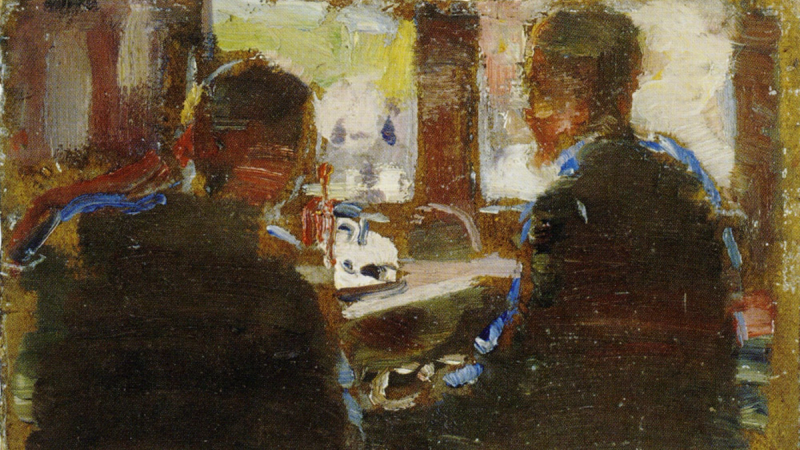
Image: "Two Men by the Window," by Edvard Munch (1863–1944), oil on board. {CC BY-SA 4.0} Cropped by MR.
Footnotes
Wilfred Owen, "Dulce et Decorum Est" from Poems, ed. Siegfried Sassoon. New York: The Viking Press, 1921. Public domain.
BackDepartment of the Army, FM 7-22, Holistic Health and Fitness (Washington, DC: Government Printing Office, 2020).
Back