
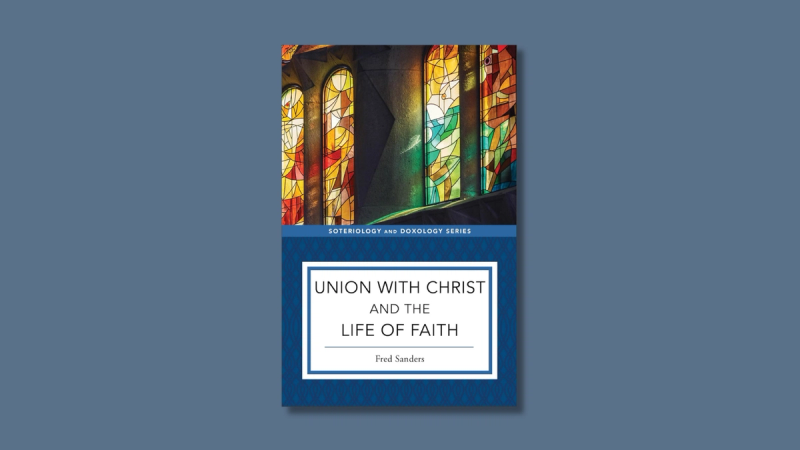
Union with Christ and the Life of Faith
By Fred Sanders
Baker Academic | 2025 | 176 pages (paperback) | $22.99
Christian theology is a vast expanse in which a dizzying array of doctrines orbit a single Son that holds them in their courses. We ought not dismiss any of these doctrines as unimportant, but there are some that sit at the heart of the Christian faith, while others are more peripheral. At the center we find God’s role as Creator and the fact that we are made in his image, truths upon which all else depends. But as Fred Sanders rightly argues in his newest book, Union with Christ and the Life of Faith, pride of place should also be given to the three mysteries of union.
First, by logical order is the doctrine of the Trinity, that “indestructible, incorruptible oneness” that is “the source of the other unities” (108). Second is the hypostatic union, by which the Second Person of the Trinity, the Son of God, took human nature upon himself. Third is our union with Christ, both as individual believers and as part of the collective Bride of Christ, the church. “Viewed from above, our union with Christ is the nearest edge of an integrated series, a cascading reality of unions and unifications, onenesses flowing downward from the one God to heal our divisions and disintegrations” (108).
It is therefore easy to see why Sanders would focus on this topic for Baker Academic’s “Soteriology and Doxology” series. (Previous volumes examine the atonement and glorification.) As explained in the book’s preface, this series was developed for theological students and seeks to connect doctrinal argument to immediate praise. Sanders writes about union with Christ, “This kind of soteriology, properly centered on the sōtēr (savior), is the kind most fully open to doxology, because it is already focused not only on salvation but on the one who is to be praised for salvation” (xii).
Focusing on union with Christ also allows us to see the commonality between differing Christian traditions.
To think of Christian traditions as being parceled out and divided up among competing soteriologies is too loose; it illegitimately gives too much importance to the differences within the continuum of belief … The soteriological lay of the land, I want to argue, is the domain of the doctrine of union with Christ. There is one Christian soteriology, and that is, by definition, salvation by union with Christ (4).
It is this basic understanding of union that has “generated the ancient creeds and guided the ecumenical councils, and it continuously underwrites doctrinal contemplation of salvation in a vast array of classic theological sources and their reception” (10). All the benefits of Christ come to us through union with him. “Because we are in Christ, we have forgiveness of sins, resurrection of the body, and life everlasting” (16).
Sanders proceeds through chapters examining where union with Christ is found in Scripture and the ecumenical creeds, how it connects with the Christian life, and how it has been variously explored in Christian writing. Perhaps most crucial is his chapter on “Union with Christ as Trinitarian Soteriology,” and this Trinitarian theme appears throughout the book.
“Nothing else unites believers to the salvation that the Father has placed in the Son except the Holy Spirit,” (60) Sanders writes, and he notes this Trinitarian connection in the writings of John Calvin. “Vertically, Calvin directs our attention upward, from the act of faith by which we obtain union with Christ to the heavenly reality of the Third Person of the Trinity, the Holy Spirit. The Spirit provides the ‘secret energy’ of our faith in Christ. This movement of thought is a trinitarian tour de force” (59).
Sanders also discusses another popular Reformed way of considering salvation—the ordo salutis (order of salvation)—and how it relates to union with Christ. “Theologians simply need to bear constantly in mind, as they work with the ordo salutis, that everything in it takes place inside the union with Christ, or even more simply, more obviously, and more biblically, in Christ” (96), he explains. “In particular, as we undertake to bring union with Christ together with the ordo salutis schema, we should bear steadily in mind that we are not departing from predictable Protestant sources but merely making sure to take seriously what Protestants themselves have consistently claimed about union” (105).
As Sanders notes, union with Christ is a universal Christian theme. There is no shortage of literature on the market discussing this topic, from writers both ancient and modern. There are also many potential aspects of union with Christ left unexplored in this volume, such as the Eastern Orthodox focus on theosis, the role and purpose of the sacraments, and the full flourishing of union in the beatific vision.
Sanders engages almost solely with the Protestant tradition, specifically its Reformed variety. This is due to the constraints of the series, as Sanders acknowledges. “It would be a great and sweeping project to gather up and consider together all the ways of understanding and articulating what it means to be in Christ. But in a book of this length, strict selections have to be made, and only a few related trajectories can be traced” (140).
Sanders’ other works indicate he is not ignorant of the way other Christian traditions have considered this issue, adding their own thematic twists. But this book is meant for students who are bombarded with endless reading lists, and for whom a briefer introduction is likely a welcome relief, particularly one that considers the impact of this doctrine on the life of the average Christian. What makes Sanders’ book more unique, besides his skill for communicating complex subjects in a digestible manner, are the doxological interludes. From the medieval Anima Christi to John Wesley’s “Thou Hidden Source,” Sanders selects prayers that guide the reader into contemplation upon the wondrous mystery of our union with Christ.
Union with Christ and the Life of Faith is a good introduction to the topic that can serve as a jumping off point for further considerations. It is particularly commendable for its link with Trinitarian theology and doxological elements. I recommend it for theological students, pastors, and interested lay persons.