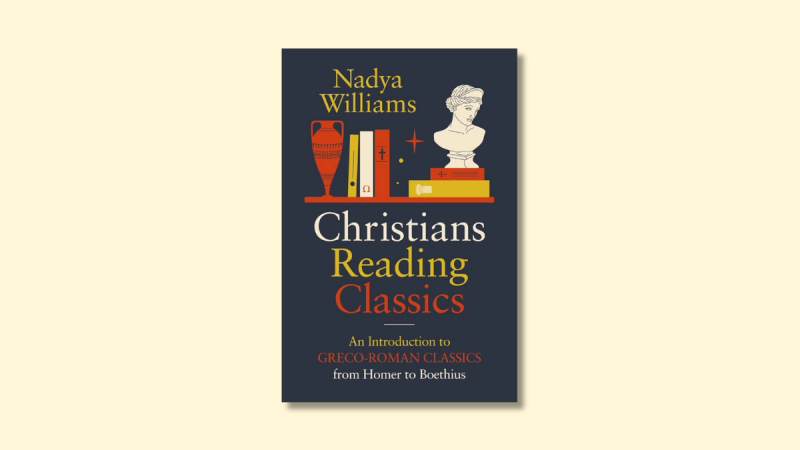
Christians Reading Classics: An Introduction to the Greco-Roman Classics from Homer to Boethius
By Nadya Williams
Zondervan Academic | 2025 | 299 pages (paperback) | $32.99
This is a tough time to be a professor of classics, the study of ancient Greek and Roman literature and culture. Howard University has joined the ranks of those scrapping classics degrees, Princeton no longer requires classics majors to take Latin or Greek, and some are complaining that the whole discipline is rooted in white supremacy. Even Oxford University announced this past year that it would scrap its undergraduate classics degree, although it turned out to be an April Fool’s joke.
Growing up in the former factory town of Muskegon, Michigan, I knew only one person who had taken Latin classes: my own father, who had hoped it would prepare him for all that Latin terminology in medical school. He assured me it proved fruitless and discouraged me from making the same mistake with the popular maxim, “Latin’s a dead language—as dead as it can be. It killed off all the Romans, and now it’s killing me.” He need not have warned me, for it was only in graduate school that I even had the option of studying Latin.
Into this complicated situation steps Nadya Williams with her book Christians Reading Classics. She stands as part of an expanding group of Christians in the United States who emphasize the salubrious effect that classics have on developing minds, and not only because it allows them to understand the word salubrious. Her goal in writing is “to encourage Christians to read the Greco-Roman classics as Christians and to equip them to do so productively by providing a thematic and chronological introduction to key authors in all periods of Greco-Roman literature, from Homer to Boethius” (xi). This is exactly what she does, devoting each of the twenty chapters to a different author or authors and examining what principles they have to share.
The question of whether Christians should read pagan authors is as old as Christianity itself, but Tertullian’s famous quip, “What does Athens have to do with Jerusalem?” was not an anti-intellectualist statement. As Williams notes, he was “not calling Christians to reject education (including pagan learning) as unnecessary but rather to probe deeper” (250). The biblical authors and Church Fathers made use of the knowledge contained in these classic texts while interpreting them in light of revealed Scripture. Even so, “Christians should read the Greco-Roman classics while remembering their own identity in Christ and seeing the pre-Christian antiquity in dialogue with this identity” (xiv).
Sometimes, the very absence of the true God in classics can reveal spiritual truth. The literature of the ancient Greeks, so rich in praise for heroic acts, speaks to a longing for the eternal.
Reading the Homeric epics as Christians, we can see a God-shaped void—a yearning for something greater than what the Greek bards and their audiences could ever see here on earth—even in those heroes of the pagan world and in the gods, who (in the Greeks’ imagination) populated the landscape all around them. (5–6)
The pagan gods are simply not good enough, and the ancient Greeks “gently whisper this truth to us under their breath, even while humoring us with their tales of failed quests of individuals and states for eternal glory through earthly acts” (53). The Greek gods possess the worst qualities of humanity rather than transcending them, and there is much that they cannot control. “Petty in their treatment of each other and of the human race, suspicious of everyone, and ever power-hungry, the gods live a miserable eternity that seems more curse than blessing” (21–22).
The God of the Bible, on the other hand, is truly almighty. “God alone knows eternity, feels it, and is master over it. The longing for eternity, knit into every human being, is but a longing for God” (54). Not only this, but the biblical God loves human beings and is willing to sacrifice himself for them, something only the god Prometheus is willing to do in the ancient sagas (22).
Classical authors do show a strong interest in the development of civic virtue, a quality that is surely admirable. “Virtuous neighbors, after all, are the best kind of neighbors,” Williams notes (112). However, she rightly observes that this is something less than the theological virtues of Christianity.
The pagan religious traditions could hand down rules—for instance, the gods hated blood pollution, so murder was certainly bad. But these traditions could not provide for true, genuine transformation of character beyond just getting someone to follow the rules. They could not explain why—to use the example of murder again—something was so bad. (252)
The word virtue is derived from the Latin term virtus (“manliness”), and Roman authors portrayed their virtuous heroes as towers of strength. They were invariably “famous politicians and generals—an overlapping category, for to be one was always to be the other.” It took a change of religion to re-write the narrative of heroism. “Only after the rise of Christianity do we see different sorts of heroes arise: the meek, the lowly, and the ones willing to die for their faith” (218).
Williams acknowledges that her book “is not meant to be the final word—but it seeks to encourage you to dig deeper for yourself and find the joy of reading the Greco-Roman classics, just as two millennia of earlier Christians have done” (275). It is written in an engaging style accessible to the average layperson and includes suggested editions of classical works, questions for discussion or contemplation, and a section in each chapter that briefly explores a related issue.
Christians Reading Classics is an excellent introduction for those making their initial foray into classical literature, as well as a helpful thematic overview for the dedicated student, tracing the common threads through disparate authors. You will walk away convinced of the importance of classics not only in shaping the intellect, but also in shaping the heart.