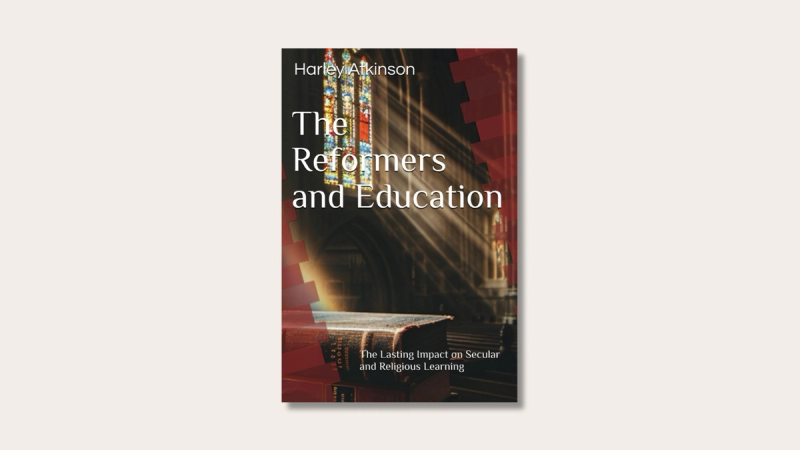
The Reformers and Education: The Lasting Impact on Secular and Religious Learning
by Harley T. Atkinson
Independently Published | 2025 | 380 pages (paperback) | $24.99
The Protestant Reformation sought to restore Christian doctrine and worship practice in accord with Scripture. But this had implications far beyond the walls of the church, impacting the home, the school, and society. Veteran educator Harley Atkinson gives us the broad sweep of educational change sparked by the Reformation in his book The Reformers and Education. As he puts it, this book “seeks to explore a less-traveled facet of the Reformation, the profound influence it exerted on education—both religious and secular” (7). The Reformation’s emphasis on “literacy, personal Bible study, and the spread of knowledge…led to significant changes in educational practices and institutions” as many Reformers even “advocated for education for all social classes, not just the elite, to ensure that everyone could read the Bible” (15). Both Christian and secular education have been shaped in theory and practice by the Reformation. It’s a story worth telling, and Atkinson tells it well.
Background
The book begins with an overview of the history of Christian education leading up to the Reformation, along the way highlighting things like the catechetical schools of the early church and the cathedral schools of the medieval era. While there are clear differences in educational and catechetical approaches of Christians throughout history, what is evident is the importance placed upon education and catechesis. To be sure, any historical overview of this nature simplifies things to a certain extent, and one might find some points to quibble with in his recounting of the history, depending on your area of expertise.
For example, he argues that the catechumenate mostly disappeared after the fifth century, “largely due to the introduction of infant baptism” (31). Another point up for historical debate is his claim that scholasticism, with its “emphasis on the authority of Aristotle and other ancient philosophers as well as the teachings of the Roman Catholic Church,” often led “to a neglect of critical thinking and a blind acceptance of dogma.” (43). Is this really a fair representation of scholastic theology? And how does that relate to the Lutheran and Reformed Scholastics who continued employing scholastic methods and categories during and after the Reformation?
Quibbles like this aside, Atkinson helps the reader understand the basic flow of Christian education and its status as the Reformation neared. Across Europe, while educational opportunities were already growing on the eve of the Reformation, Atkinson points out that “mandatory universal schooling was non-existent across Europe, and it was here that the Reformation movement had one of its most profound and impacting influences” (54).
Reformation Streams
As he moves from background to the subject of the book proper, Atkinson highlights major figures that emerge within different strains of the Reformation, from Luther and Melancthon to Calvin and Knox. In addition to recognizable names, he highlights the contributions of lesser-known figures, like Johannes Sturm, Katharine Shutz Zell, Richard Mulcastor, and Ignatius of Loyola. He makes it clear that education was changing in all the countries touched by the Reformation and Counter-Reformation.
This approach of highlighting key contributors from around Europe and from across different Christian traditions is effective in painting a vivid picture of just how widespread the changes were. One example that I especially found interesting was in Scotland. Atkinson suggests that “no other Reformers—as eager as they were for the cause of education—were in a position to institute a national education system as were Knox and his colleagues” (186). The Scottish approach was “that the church be responsible for providing and supporting schools for all classes of society and both genders” (186). Atkinson goes on to explain that they envisioned education “as a cooperative venture between the home, church, and school” (186). This is a vital point that needs to be recovered in our day: how all three of these institutions—home, church, and school—need to be aligned and unified for education to really hit its mark in the formation of whole persons for life in this world and life in the world to come. Reclaiming this unity of faith, family, and education is something I develop at length in Education’s End: Its Undoing Explained, Its Hope Reclaimed.
Reformation Fruits
Atkinson makes it clear that there was no uniform educational system that emerged out of the Reformation. While some key principles can be found in common, they manifested differently from country to country, region to region, or even school to school. Some of those key principles were: “returning to ancient Greek and Roman models of education, promoting the authority of Scripture, advocating for the use of the liberal arts, emphasizing the classical languages, and embracing the teachings of the early Church Fathers” (291). Atkinson sees today’s classical education movement as an attempt to embody these principles and “revive the educational heritage of the Lutheran and Calvinistic Reformations, which in turn, have been nourished or inspired by the early Christian Church” (290).
Atkinson also argues that the Reformation’s reach can even be seen in some forms of home education, which draw heavily on the Reformers who emphasized “the importance of parents being actively involved in their children’s education, seeing the family unit as a crucial environment for instilling Christian beliefs and values in children” (268).
There are bits and pieces of the Reformation that still shine through in many forms of education today. Whether in public schools, which borrow from the Reformation’s emphasis on universal education for all; or in parochial schools, which draw on the catechetical focus of many Reformation schools; or in classical schools, which revive the ad fontes principle; or in homeschools, which connect to the Reformation’s focus on the family unit. In each case, the seeds planted in the Reformation have grown into something significant that still bears fruit today.
Conclusion
Atkinson’s project is an ambitious one, and while some historians or theologians might demur at specific points, the benefits of his generalist approach are many in providing, all in one place, a helpful introduction and overview of Reformation education and its impacts on education in the years hence.
What readers will find in this book are the many creative ways Christians have worked toward the education of children for the glory of God and the good of neighbor. It gives inspiration and hope to our moment, where there are so many questions, disruptions, and innovations in the field of education and in the types of schooling on offer. But along with the uncertainties come many new opportunities to bring about a new reformation in education that will benefit generations to come. It is leading many families to pursue new educational options, to open new schools, or to return to time-tested methods, following in the footsteps of the Reformers. Likewise, it is leading many churches to reclaim their catechetical and educational responsibilities by embracing the rich heritage of Christian education that reunites family, church, and school into an integrated whole. Atkinson’s book reminds us that this is no novel venture, but something the church has been doing for a very long time.