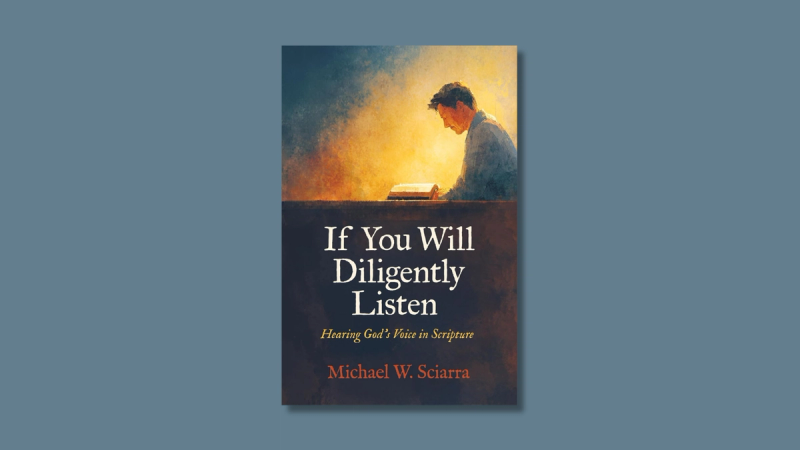
If You Will Diligently Listen: Hearing God’s Voice in Scripture
By Michael W. Sciarra
Christian Focus Publishing | 2026 | 160 pages (paperback) | $13.99
The church today finds itself amidst a revived trend of advocating for hearing God speaking to his people apart from his word. While there are new figures in this movement, the content of their message is hardly original. One can think of late medieval mysticism’s emphasis on a mystical encounter with God or the Quakers, who exalted the inner illumination of the Spirit over Scripture. There is nothing new under the sun (Eccl. 1:9). While the recurring problem persists, so, too, the same solution solves: a recovery of the sufficiency, authority and perspicuity of Scripture. For Christians seeking a lucid and helpful guide on how to advocate for such doctrines in the midst of a strong tide of different views, Michael W. Sciarra’s If You Will Diligently Listen: Hearing God’s Voice in Scripture, is such a resource.
A Timely Book
With so many books coming out at such a rapid pace, it is worth asking the question: Why was this book written now? Sciarra explains, “I write because of the widely popular and deceptive false teachers today, standing in opposition to Scripture’s authority and sufficiency, claiming God speaks apart from Scripture” (2). To prove this claim, he takes two chapters to survey various individuals who advocate the view that God speaks to people individually and personally apart from his revealed word. Initially, attention is drawn to major figures such as Dallas Willard (1935–2013) and Henry Blackaby (1935–2024), both crucial individuals in this trend within modern evangelicalism.
From there, Sciarra surveys this view amongst prominent evangelical figures today, such as John Mark Comer and John Eldredge. As a Presbyterian pastor, I was aware that such a belief existed, but unaware of just how widespread it has become amongst many evangelicals today. A major strength of this book is educating its readers on just how prominent this belief is as evidenced through the plethora of citations from works written by proponents of the view. As a reading practice, I often write exclamation points in the margins when I find something interesting or shocking. In these first two chapters, I found myself writing exclamation points next to quotes on each page out of pure shock. John Eldredge, on seeking to discern God’s answers to his questions, writes, “Still in quiet surrender, I ask the Lord, is it yes, you want us to go? Pause. In my heart, I am trying it on, letting it be as though this is God’s answer … By trying on the possible answers, I find it enables me to come into alignment with his Spirit” (32). If this is indeed as prevalent a method of deciphering God’s will as Sciarra claims it to be, then there is certainly a need for this book.
Defending the Sufficiency of Scripture
The cure this book provides to this problem of personal revelation is a recovery of the sufficiency of Scripture. In an age of confusion and questioning whether Scripture alone is sufficient for the Christian life, Sciarra does a good job defending the doctrine. He writes, “The sufficiency of Scripture means the Bible contains all the words of God He wanted us to have for salvation and for growth, everything we need for trusting and obeying Him” (61). Sciarra still gives guidance to earnest Christians who have questions about their lives, but encourages them to seek help through applying the principles of God’s word to their lives rather than expecting a personal spoken word.
For a book about Scripture, the author avoids irony in rarely citing biblical passages alone, but in interacting with them in a way that tries to illustrate the truth of his argument. The reader is confronted with the truth and beauty of God’s word on nearly every page. Especially helpful is the section that does exegesis on popular passages used by those who promote the idea of God speaking apart from his word (74–82). Although, it is curious that Sciarra does not interact in depth with 1 Samuel 3 here, given that many authors examined earlier cite that passage as a support for their view.
While demonstrating that God’s word does not promise that we will receive private revelation, the book draws attention to a wonderful fact: God does speak to us in his word (Heb. 3:7; 4:2, 7). Because of this, attention is drawn to trusting the Spirit to illuminate God’s inspired word to his people (1 Cor. 2:6–16). Both of these facts help exhort readers to rich meditation on Scripture that will yield a delight in the Lord (Ps. 34:8). In doing so, Sciarra draws out one of the wonderful implications of trusting in the sufficiency of Scripture: It leads God’s people on a sure path towards delighting in and enjoying the riches of the Lord through his word (93–98).
Pastoral Guidance
Far from just defending the sufficiency of Scripture in a theological sense, Sciarra shows the rich and beautiful implications for the Christian life in holding to such a view. Even when engaging with those who disagree, the book frequently instructs Christians to be gracious, gentle, and prayerful (51, 111–112). While it may sound good in theory to believe that God does speak to people apart from Scripture, this book draws Christians back to the biblical truth of who God is and how we should expect him to work ordinarily in the life of a believer. Sciarra writes, “This is not merely about semantics; it is about our understanding of God and how He works” (109). Exactly. While some prominent and influential church leaders communicate that we should anticipate hearing God speak to us outside of his word, it is crucial to recover the freedom of trusting in God’s word alone. The church needs to recover teaching the ways God has promised to work—through his Holy Spirit and the ordinary means of grace—in the lives of believers rather than being shackled by unbiblical expectations.
In light of the power of the word, Sciarra urges churches to give a prominent role to Scripture in worship services, both in the reading and preaching of the word, and also in discipleship, all of which leads Christians to a deeper maturity in their faith and relationship with God.
Finally, the book concludes with a focus on what the main goal of a word-centered life is: the glory of Christ. Helpfully, several practical examples are laid out about how Christians can treasure Christ by faith and through his word. Sciarra notes, “The more you cherish Christ as your greatest treasure, the more saturated with Scripture you will want to be; your thoughts flavored by, answers shaped and desires bent to God’s self-revelation in Scripture” (130). May the Lord be pleased to use the words of this book to draw us back to his word and to his Son, the Word, his fullest revelation.