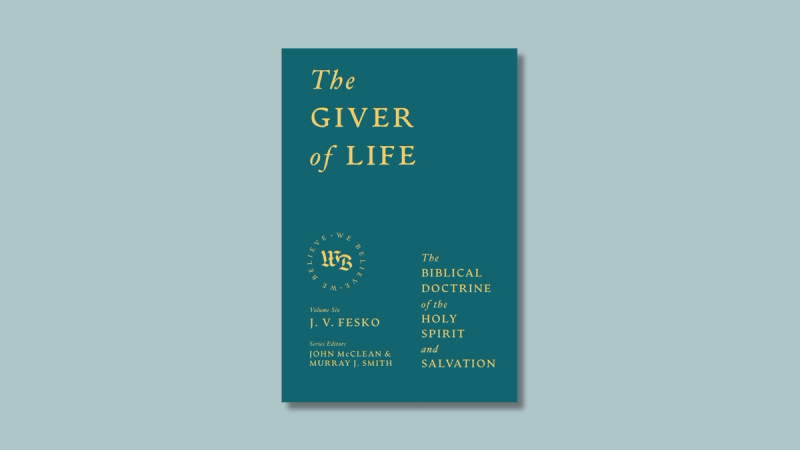
The Giver of Life: The Biblical Doctrine of the Holy Spirit and Salvation
By J. V. Fesko
Lexham Academic | 2024 | xxxiv+338 pages (hardback) | $36.99
Even though John Calvin has been dubbed the “theologian of the Holy Spirit,” his theological heirs, Reformed Presbyterians, are sometimes maligned as giving the Holy Spirit the short shrift. I remember visiting a friend’s charismatic church during college and being told that I “didn’t have much of the Spirit” because I did not speak in tongues (understandable, given my belief that tongues ceased after the New Testament times). That’s a quite shocking assertion about a fellow Christian, and I would go so far as to say that the Reformed emphasize the person and work of the Spirit more than others. We hold that a Christian’s ability to believe and do any good work comes “wholly from the Spirit of Christ” (Westminster Confession of Faith 16.3). The Reformation also emphasized the need for the Holy Spirit’s active influence, against the teaching that sacraments work automatically (ex opere operato).
J. V. Fesko’s new volume, The Giver of Life: The Biblical Doctrine of the Holy Spirit and Salvation, strongly reinforces the assertion that Reformed theology is bound to a strong doctrine of the Holy Spirit. Sunday after Sunday, Christian congregations recite the Nicene Creed, confessing that they “believe in the Holy Spirit, the Lord and Giver of life.” Fesko’s work is part of the “We Believe” series put out by Lexham (recently acquired by Baker), which takes lines from the creed and explains their biblical foundations and theological implications. The Giver of Life thus serves as an introduction to the doctrine of the Holy Spirit and the application of salvation to believers, like a course found in seminary curriculum.
While The Giver of Life covers the most significant systematic theology topics related to the Spirit, the first third of the book presents a more biblical-theological approach, delving into how the Scriptures describe the Holy Spirit. Part I, “Covenant Presence,” takes readers on a tour of how the Old Testament describes the Spirit. Old Testament pictures of the Spirit inform how the New Testament speaks of the Spirit, as in 1 Corinthians 3:16: “you are God’s temple and… God’s Spirit dwells in you” (17). The “temple” image shows how God dwells with us by the Spirit, and another powerful picture of the Spirit is his guiding God’s people by fire and cloud (e.g., Neh. 9:19–20, 30). One of the great features of this work is how interwoven everything is: even in the biblical sections, he makes theological points (e.g., 24–25), and in the theological sections, he continually returns to biblical data. Biblical trajectories result in theological formulations, and practical application, such as when Fesko writes, “The pillar of cloud and fire no longer rests over the tabernacle or temple but, since the outpouring of the Spirit at Pentecost, now rests on individual believers. This means we have greater access to the Spirit’s intercessory work in prayer” (98).
It is often said that Reformed theology is covenant theology, and Fesko shows that the Spirit is actively involved in dispensing the covenant blessings won by Christ to believers. Scripture says that “The Spirit himself bears witness with our spirit that we are children of God” (Rom. 8:16). This Spirit-enabled adoption is a blessing won by Christ’s fulfillment of the Davidic covenant (e.g., 49). These sections show not only the exalted place that Reformed theology gives to the Holy Spirit, but also how Reformed theology’s various doctrines are woven together.
Before addressing the Holy Spirit’s role in redemption, the Spirit in himself must be defined—that is, the doctrine of the Trinity—and this is where The Giver of Life’s dogmatic section begins (109). Fesko deftly recounts biblical data on the person of the Spirit and weaves in orthodox expressions from across the ecclesial landscape, relying on ancient and modern sources (e.g., 112–115). However, the book is relatively short, and this means that complex topics like the Spirit’s procession from the Father and the Son (filioque) are only mentioned with footnotes to deeper discussions (see 110). Nevertheless, without mentioning all the ancient or contemporary Trinitarian discussions, Fesko shows familiarity with them, such as noting that “The intra-Trinitarian processions lead to the Trinitarian missions. Alternatively stated, ontology leads to economy” (115).
This sounds complex, but readers of all levels will find something here in this erudite yet pastoral work. For example, Fesko notes Heidelberg Catechism Q&A 53, asking what is believed concerning “the Holy Spirit,” and answering: “First, that the Spirit, with the Father and the Son, is eternal God. Second, that the Spirit is given also to me, so that, through true faith, he makes me share in Christ and all his benefits, comforts me, and will remain with me forever” (120).
Chapter VIII, “Sanctification,” is one of Fesko’s best. What makes Fesko’s presentation uniquely helpful is that he highlights realities that are often neglected, such as the fact that faith looks to Christ not only for justification, but also for sanctification (176). Owen speaks this way: “Set faith at work on Christ for the killing of thy sin” (176). Biblical sanctification is extraspective, as is justification: “Paul’s exhortations [in Eph. 4:22–25] flow from the fact of union with Christ, not merely from the force of the bald imperatives. In other words, Paul is not saying, ‘Try harder!’” (177). “Sanctification is part of the gospel, and thus we do not receive the gift of the gospel by works” (185). As Westminster Confession 14.3 points out, “The principal acts of saving faith are accepting, receiving, and resting upon Christ alone for justification, sanctification, and eternal life, by virtue of the covenant of grace” (186, italics added).
In explicating the difference between justification and sanctification, Fesko points to a glorious truth: “Justification is complete the moment God declares a sinner righteous and is irreversible” (180). Justification, our right standing with God, is, in the words of Turretin, “in a judicial sense the root of our sanctification” (181).
Another distinctive aspect of Fesko’s chapter on sanctification is his explanation of the Christian’s “new disposition” as a “habit of faith” (178). Because Protestants rightly recoil from the Roman Catholic intermingling of faith and works in justification, we sometimes forget that even our tradition holds that God imputes righteousness to believers in justification (e.g., Rom. 4:5), and “in sanctification God infuses grace” (179, italics original; WLC Q&A 77).
The seed of God that the Spirit implants at regeneration and the grace he infuses in believers for sanctification does not mean that our growth in holiness is smooth sailing. Westminster Confession 17.3 states that a fall into great sin deprives a believer of some measure of intimacy with God, and Fesko picks up on this reality: “Think back to Leviticus and the degrees of intimacy. The more the Spirit sanctifies a believer, the closer his communion with God is—his sanctity allows him to draw nearer to God” (177). Such observations are reinforced in Fesko’s excellent chapter on assurance (213–227).
Another often overlooked work of the Spirit that Fesko explores is the Spirit’s role in giving God’s people wisdom (102). Wisdom is also important for sanctification; Calvin spoke of man’s “wisdom” as comprised of two parts, knowledge of God, and knowledge of ourselves (188–9), and Fesko argues that “Prior to the enlightenment, theologians recognized that theology was chiefly about the pursuit of wisdom” (189). “Learning who God is leads to loving him, and loving him leads to fearing him—to wisdom” (189).
Here Fesko covers the Westminster Shorter Catechism’s first question and answer, about man’s chief end being to glorify God and enjoy him forever. Fesko rightly roots this language in Augustine’s distinction between uti (use) and frui (enjoyment), and suggests that “if we approach God only for uti (‘use’), then we fail to embody true theology and wisdom.” Instead, frui means “loving and praising God chiefly for who he is and secondarily for what he has done. Such an attitude embodies sanctified wisdom” (190). Theology is wed to piety, scientia leads to sapientia (190). Further, “With each step forward in sanctification, we learn to glorify God and enjoy him forever” (191). This twin telos of the Christian life returns repeatedly in these final chapters (e.g., 259, 261–2, 267), with a practical bent: “We must ask whether we are merely using prayer or enjoying God in prayer” (163).
I heartily recommend The Giver of Life to be read widely. It could be used in Sunday school and read by laypeople. Given its brevity, it is unlikely to replace systematic theology volumes like Berkhof and Bavinck in pastors’ libraries; however, because it covers much important biblical ground and important practical-theological loci, along with its edifying warmth, it should serve as a helpful supplement. The Giver of Life confirms that Calvin’s legacy continues: Reformed theology is, in important senses, theology of the Holy Spirit.