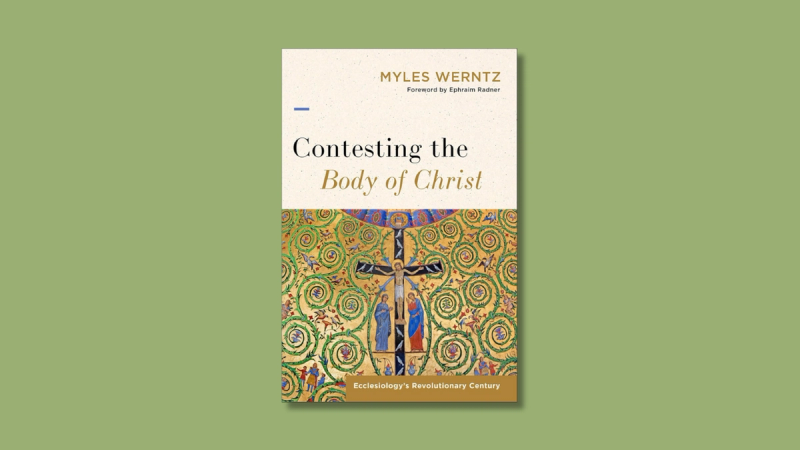
Contesting the Body of Christ: Ecclesiology’s Revolutionary Century
By Myles Werntz
Baker Academic | 2025 | 184 pages (paperback) | $24.99
The scope of the twentieth century is best summarized in two facts: at its beginning Queen Victoria existed, and at its close Google existed. The twentieth century exceeds all others in its rapid change and seismic events. Two World Wars, the demise of colonial empires and creation of new nation-states, the rise and fall of the Soviet Union, a complete shift in global monetary and trade systems, the introduction of antibiotics and birth control, the digital revolution, and the expansion of literacy and education all helped create the world in which we now live. Every one of these developments also impacted the church of Jesus Christ.
In his book, Contesting the Body of Christ: Ecclesiology’s Revolutionary Century, author Myles Werntz attempts to make sense of one of the church’s most consequential periods, analyzing trends that are still playing out today. He has much to explore, from the establishment of new churches due to political realignment, to the genesis of the ecumenical movement, to the reforms of the Vatican II council, to the full emergence of Pentecostalism. Werntz explains, “This is a book that asks what we learn about the nature of the church from looking at how ecclesiology in the twentieth century discussed, embodied, and contested the four marks of the church: one, holy, catholic, and apostolic” (1).
While the Protestant reformers identified marks of a true church that included right preaching of the word and administration of the sacraments, Werntz chooses the criteria of the Nicene Creed as his guiding metric—unity, holiness, catholicity, and apostolicity—devoting a section to each. Central to his exploration is a focus on the work of the Spirit as the giver of divine gifts, including the very essence of the church, which is established by God and not humanity. This focus on the Spirit is ideal for an ecumenical exercise.
“By beginning with this double assumption—that 1) the Spirit makes possible our confession of Christ and the constitution of the church and 2) the Spirit’s presence brings with it these marks of what a body of Christ is—we can begin to ask new kinds of questions born out of curiosity, asking how this is so rather than presuming that it is not so.” (8)
Werntz stresses the importance of material and contextual factors for the twentieth century church. Christians in all three main branches—Roman Catholic, Orthodox, and Protestant—were forced to grapple with expanding possibilities of what the church could be. For example, he notes that while “the relationship between the catholicity of the church and the unity of the church broadly separates Catholic and many Protestant conceptions of catholicity,” both traditions have also had to adjust to the rise of global (and globalized) Christianity. “For much of Christian tradition that depicts the fullness of what Christians confess—Catholic, Protestant, and Orthodox—depends on certain material, cultural, or metaphysical assumptions not shared by all corners of the church, or all corners of the world” (97).
Not only has the church been forced to wrestle with culture as the gospel has expanded into new regions, but it has also wrestled with its own history. The end of colonial empires and the blossoming of the Civil Rights movement forced the church to revisit its own previous actions and confess that while sin may be committed by individuals, it also has long-lasting effects upon generations. This is part of the work of contestation.
“For if the church is that body of Christ which is embedded in time, it will never be free of the wounds of time, for better or worse; no amount of doctrinal scrutiny might make the church pure, for the wounds of the past are part of what the Spirit has worked through to make the present church what it is. Repair is part of that endless work of time, with the work of internal interrogation being part of what is appropriate to being a living sacrifice.” (89)
The book’s concluding section takes Werntz’s consideration into the present and future tenses, looking at how the lessons of the twentieth century can shape our efforts in the twenty-first. “To say that the church is one, holy, catholic, and apostolic is to say that the church is a body given by the Spirit to be complex, transcultural, transhistorical,” he writes. “It is a body of Christ that has, over time, developed striations and dimples, pockmarks and changing hairlines; it is a body that has aged, been renewed, been strengthened and weakened” (157).
Werntz uses the imagery of sacrifice to describe how this contestation affects the church. By the work of the Spirit, “a fire that burns but does not consume gives rise to a people who are changed but not destroyed” (159). The church is a living sacrifice even as we its members are living sacrifices, and God will make of us what he wills. Through our engagement with other portions of the church, we are not destroyed but renewed.
“With this motif of the church in view, we are able to view the contestations of the twentieth century—and indeed, of all the time before it—as less a history of ideas than a history of the Spirit immolating those elements that we wish to salvage from the fire but that were always meant to be transfigured in sacrifice.” (161)
This means that contestation is “the process by which the church must discern what it means to receive the gifts of God to the church well and not resist the changes that these gifts will make” (164). The church is a creature of the Spirit, united with the Son, ordained by the Father. It is God who makes the church one, holy, catholic, and apostolic.
Contesting the Body of Christ is an academic work and will be enjoyed most by students and scholars, whether professional or amateur, ordained or lay. Caught in the book’s middle sections, with their discussion of church gatherings and pontifical documents, it is possible to miss the forest for the trees. However, the final section reveals what Werntz has been working toward: an understanding of the church as something in constant flux, holding firm to the truths of God’s word but nonetheless shaped by each historic and cultural encounter. This book is therefore not simply a study in church history, but a handbook for the church’s future.