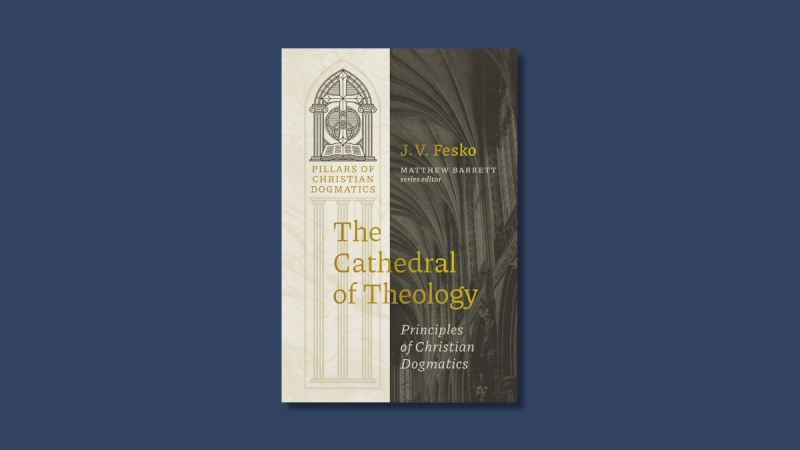
The Cathedral of Theology: Principles of Christian Dogmatics
By J. V. Fesko
IVP Academic | 2026 | 448 pages (hardcover) | $64.99
When Dr. Fesko chose the topic of the imagination to introduce to our church his new book, The Cathedral of Theology: Principles of Christian Dogmatics, I immediately knew I wanted to read it. His description of a chapter about the place of imagination in theology was enthralling. Often dismissed as “the stuff of fantasy,” the imagination is rarely discussed in theological books.
But if this topic was the hook that drew me to his book, what kept me reading was the author’s unwavering commitment to lead his readers toward the ultimate goal of capturing “a glimpse of the beauty of the triune God” (xvi) and his concerted effort to walk with them, step by step, in this pursuit.
This is what sets this book apart. It is not a work of systematic theology, which typically aims at organizing doctrines into an orderly system. Fesko describes it as a “work of prolegomena which establishes principles for theology.” (3) But it is more than that. Rather than drawing a map or a blueprint for readers to follow, Fesko walks with them, showing how to draw from the riches of their Christian tradition and to give “more careful thought to the theology of their theology” (xvi).
The illustration of a cathedral is fitting—particularly one of the grand European cathedrals which “were built to last for centuries.” (4). Just like these cathedrals were patiently built stone by stone, Fesko walks with us chapter by chapter, starting by laying out the definition, task, and goal of theology and the necessary virtues and habits of a theologian (another feature most theological treatises omit) and moving through the major foundations of Christian dogmatics. Through this journey, he constantly reminds readers that the beauty of God is both the chief goal of theology and “the very road on which we travel.”
Fesko's treatment of the virtues and habits of a theologian is in itself a reason to read this book, as it represents an important reminder of the love, humility, selflessness, courage, patience, and diligence we need to maintain throughout our study, as well as the practices of prayer, simplicity of life, physical wellbeing, and proper reading habits that will sustain us. And Fesko doesn’t just list these virtues, but is an example of an earnest commitment to achieve them.
Given Fesko’s description of the book to our church, I had braced myself for a scholarly work requiring deep intellectual engagement. To my surprise, I found it quite accessible, far from the work of authors who, according to Nietzsche, “muddle their water to make it seem deep” (12). Fesko, who includes this quote in the book’s introduction, is aware of the danger of scholarly murkiness and avoids it masterfully.
What makes this book accessible is its clarity and organization. The structure is carefully planned to include clear introductions, concise conclusions, suggestions for further study, and visual aids. Seminary students and pastors may find its language more familiar than the person in the pew but, speaking as a person in the pew, I believe this book allows any committed reader to engage with it, especially since it abounds with precise definitions and engaging examples which eliminate ambiguity and clarify abstractions.
Fesko’s explanation of metaphysics, for example, is so clear that a child could understand it. Using everyday examples such as a child helping himself to cookies, a log thrown into a fire, and a bedtime story of a boy that turns into a dragon, he illustrates concepts of cause and effect, potency and actuality, and being and nonbeing.
The chapter of the imagination, described as “a power of the intellect that gives humans the ability to grasp the meaning of truth” (315), comes toward the end of the book as a neglected tool which, bridled by the authority of Scripture, “gives insight into the transcendent nature of the triune God” and allows us to “stretch our understanding of truth” by giving proper and humble consideration to other theological traditions rather than taking “an all-or-nothing approach” (334). Jesus knew the value of the imagination, as his parables demonstrate.
Quite fittingly, beauty is the topic of his last chapter, as “an indispensable and logical part of theology, practice, and ultimately worship” (360). For Fesko, capturing this beauty means not only recognizing God’s beauty in creation and Scripture, but reflecting beauty in theology and life—“whether we behold God’s beauty in the creation, gaze on his beauty in Scripture, or, like the moon reflecting the brilliance of the sun, reflect God’s beauty and glory in our theology” (13).
“Aesthetic theology,” he says, “is not a pursuit of beauty for the sake of beauty but rather an effort to trace the beauty of the triune God—that we, lowliest of creatures, share in the privilege of reflecting God’s beauty in this sin-darkened world” (376).
Fesko puts his own advice into practice. In spite of the weightiness of his subjects, his writing moves with seemingly effortless ease through a sequence of precise definitions, historical facts, practical examples, thought-provoking questions, and uplifting quotations that make his prose both lucid and lyrical.
If Fesko’s proposition that “the cycle of dismal theological writing perpetuates itself because theologians continue to digest tedious books” is true, this book will break that cycle for future writers and speakers.
The Cathedral of Theology is a book that can be read over and over and highlighted or diagrammed for future reference. The large bibliography at the end is a feast for those who like to delve deeply into subjects.
Most of all, this book is faithful to remind readers that the goal of building a theological cathedral is not “to construct a grand edifice to our brilliance and intelligence. Rather, our desire should be that the triune God inhabit the cathedral because it is built from, to, and for him. Our doctrinal cathedral would therefore serve as a meeting place between us and the triune God—a meeting place of truth, beauty, and glory that would showcase ‘the riches and wisdom and knowledge of God.’ (Rom. 11:33)” (379). The Cathedral of Theology is a worthy guide for those embarking on this venture.