We currently inhabit a unique historical moment that the sociologist Philip Rieff presciently termed the "triumph of the therapeutic." The great secular project of the twentieth century made a specific promise: if we dismantled the external structures of religious law, we would finally be free from the crushing weight of religious guilt. We were told that shame was an artificial construct of the church—a mechanism of control—and that once we abandoned the idea of a judging Deity, the human psyche would finally be light. We would be free to create our own meaning, unencumbered by the "thou shalt nots" of a bronze-age God. The concept of sin has been largely discarded, yet the psychological and sociological experience of guilt remains a dominant force in the modern psyche.
We have now lived in this secular experiment for nearly a century, and the results are counter-intuitive: We are not less guilty; we are infinitely more anxious.
The modern individual feels a low-grade, persistent fever of the soul. We see this in the explosion of impostor syndrome, a psychological phenomenon where high-achieving individuals live in constant terror of being found out. We see it in the frantic need to justify one’s existence through hyper-productivity, social activism, or the curation of a morally pristine digital avatar. We feel we are in deficit, but having erased the theology of sin, we have lost the vocabulary to name the Creditor.
This is the great paradox of the secular age: We have removed the Judge, yet the courtroom remains. We have boarded up the confessional booths, but the line of penitents stretches around the block, waiting for absolution from a silent sky.
Forensic theology proposes that this anxiety is not a malfunction of evolution or a misfiring of brain chemistry. It is a sensor. It is the smoke detector going off because there is, in fact, a fire. The debt is not a feeling; it is an ontological status. The modern man feels guilty because, in a very real, structural sense, he is guilty.
The Living Cathedral: The Universe as Legal Structure
To understand the persistence of this debt, we must reframe our cosmology. The dominant materialist worldview sees the universe as a container of empty space populated by neutral matter. In this view, morality is a "soft" social construct—a set of traffic laws agreed upon for herd survival. It is mutable and subjective. If this were true, guilt would indeed be a useless evolutionary appendage, a phantom limb pain from a religious past.
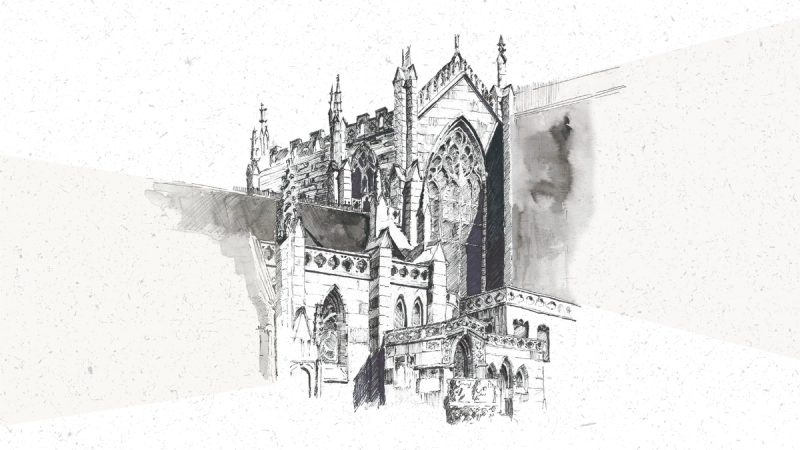
However, the biblical view presents a reality that is less like a vacuum and more like a living cathedral. In this model, the universe is built out of moral law just as a physical cathedral is built out of stone. The law is not something imposed on the universe; it is the fiber of the universe.
In a cathedral, gravity is not an opinion; it is a structural reality. If a stone is removed from a supporting arch, the structure does not merely dislike the action; the structure collapses. The penalty is not a decision the architect makes in anger; it is a consequence of the building’s nature. Similarly, sin is not merely the breaking of an arbitrary rule; it is an act of structural vandalism against the cathedral.
This forensic cosmology changes the definition of guilt. In the therapeutic model, guilt is a negative emotion to be managed or medicated. In the forensic model, guilt is a legal standing. When a man commits a crime, he is guilty, whether he feels it or not. Conversely, he may feel immense shame about something for which he is not guilty.
Our modern crisis stems from trying to treat an objective legal status (guilt) with subjective therapeutic tools (self-acceptance). You cannot "therapy" your way out of a legal deficit. You can only pay it, or have it paid. The modern soul is a defendant standing before a judge, trying to plead "self-care" as a defense against treason. It is a category error of the highest order.
The Economy of the Infinite Debt
If we accept that we exist within this forensic structure, we must address the ledger. Every human instinct confirms the existence of a ledger. When we are wronged, we instinctively demand payback. When we do wrong, we instinctively try to make up for it. We operate on a system of credit and debit because we were made in the image of a God who is both architect and judge.
The central problem of the human condition is not that we are finite, but that our debt is infinite.
Why infinite? Because the violation is against an infinite standard. In ancient law, a crime was weighed not just by the action, but by the dignity of the one offended. To strike a peer is assault; to strike a king is treason. In the living cathedral, even the smallest structural treason—a lie, a moment of pride, a selfish thought—is a strike against the infinite architect. It incurs a debt that a finite creature cannot repay in finite time.
The secular response to this infinite debt is performative justification. Having removed the atonement, the secular man must atone for himself. This is the engine behind the "workism" religion of Silicon Valley and the "activism" religion of the modern academy. We try to balance the ledger with the currency of good personhood. We volunteer, we post the correct political opinions, we recycle, we work 80 hours a week to prove our utility.
We are desperately trying to pay an infinite mortgage with Monopoly money. This creates the exhaustion of the modern age. We are running on a treadmill, trying to outpace a debt that compounds faster than our righteousness can accrue.
Cancel Culture: The Heresy of a Failed Court
Nowhere is the hunger for forensic justice more visible than in the phenomenon of cancel culture. Critics often dismiss this as mere mob bullying, but forensic theology sees it as a liturgical act. It is a secular heresy of church discipline—a desperate attempt to recreate the holy office of the inquisition without the mechanism of grace.
In the absence of a divine judge, the mob must appoint itself as the jury. In the absence of a defined canon law, the standards of purity shift daily, creating a Kafkaesque anxiety where one can be condemned for a transgression that was not a crime yesterday.
But the most critical failure of the secular court is the lack of a mechanism for restoration. In the Christian forensic system, there is a penalty (death) and a payment (the cross), followed by restoration (resurrection). In the secular court, there is only the penalty. Once "cancelled," there is no ritual for return. There is no blood that can wash the digital record clean. The secular sinner is exiled to the outer darkness, with no priest to hear their confession and no altar to absorb their guilt.
This is why the culture is so merciless: it is terrified. If there is no atonement available, then every error is fatal and final. We must destroy the sinner because we have no way to separate the sinner from the sin. We have forgotten how to transfer the guilt to a scapegoat, so the transgressor must bear the full weight of the structure alone.
The Great Exchange: Forensics, Not Feelings
This brings us to the crux of the argument: The mechanism of atonement.
In many modern pulpits, the cross is presented emotionally—a demonstration of how much God loves us. While true, this fails to satisfy the demands of the cathedral. Love does not cancel a legal debt; only payment does. If a judge lets a murderer go free simply because he loves him, the judge is corrupt. The law has been violated, and the structure demands justice. If God simply waved his hand at sin, he would be undoing the fabric of his own reality. He would be an unjust judge.
The narrative of Scripture, culminating in the event at Golgotha, is not a sentimental story. It is a transactional record.
We must recover the forensic language of the New Testament. The term tetelestai, cried out by Christ on the cross, is not a cry of defeat, nor merely a spiritual affirmation. It is a term found on ancient commercial receipts. It means "Paid in Full." It marks the closing of a transaction.
The central event of the crucifixion, therefore, is not the physical death alone, but the rending of the veil.
The veil of the temple was the physical manifestation of the separation caused by our debt. It was a thick, woven barrier protecting the finite debtor from the consuming fire of the infinite Creditor. For centuries, the blood of bulls and goats was splashed against this barrier—a temporary interest payment to hold back the foreclosure.
When Christ dies, the veil is torn "from top to bottom" (Matthew 27:51). This directionality is crucial. It was not torn from the bottom by men trying to break in; it was torn from the top by God breaking out. It is the physical ratification of the wire transfer. The asset (the infinite life of the Son) was liquidated to settle the liability (the infinite debt of the world).
The Freedom of the Solved Case
Why does this matter in the twenty-first century? Why should a secular culture care about ancient temple imagery?
Because the secular world is drowning in a prosecution it cannot escape. The rise of anxiety, the desperation of identity politics, and the mercilessness of public discourse are all symptoms of a society that knows it is guilty but has nowhere to take the check.
Forensic theology offers the only coherent solution to modern anxiety. It validates the feeling of debt. It affirms the modern intuition: "You are right. You are in debt. You are an impostor. You have failed to meet the standard."
But it redirects the solution. It tells the anxious modern man that looking at the ledger will not save him. Trying to cook the books will not save him.
True freedom is found in the verdict of the celestial courtroom. It is the moment the judge slams the gavel and declares that the defendant is legally righteous—not because they behaved, not because they are good people, but because the bond was posted.
We do not need more self-esteem. We do not need more affirmation. We need a dismissal of charges. And that is exactly what the rending of the veil reveals: the cross has done its work. It is the only transaction in history that clears the account of the soul, turning the living cathedral from a prison of law into a sanctuary of grace.
Footnotes
Rieff, Philip. The Triumph of the Therapeutic: Uses of Faith After Freud. New York: Harper & Row, 1966. Rieff argues that the "psychological man" has replaced the "religious man," shifting the cultural goal from salvation (vertical) to well-being (horizontal).
BackTaylor, Charles. A Secular Age. Cambridge: Belknap Press of Harvard University Press, 2007. Taylor describes the "nova effect" of secularism, where the removal of transcendence does not result in a subtraction of feeling, but an explosion of fragmented spiritual anxieties.
BackAnselm of Canterbury. Cur Deus Homo (Why God Became Man). In this foundational text, Anselm articulates the satisfaction theory of atonement, arguing that sin is an affront to God’s honor that requires infinite restitution—a debt only a God-Man could pay.
Back