Tell me, O muse, of the film of twists and turns
driven time and again off course, once it had plundered
the summer box office of 2026.
The year of 2026 is a very strange moment in our secular age. Thinking Christians are grappling with how to speak into a moment largely galvanized by polarization, AI slop, institutional distrust, and memes.
If you’re curious about cultural apologetics, you’ve most likely encountered the work of Charles Taylor, especially around disenchantment and the secular age. You’ve likely tweeted about “the vibe shift,” watched YouTube videos on metamodernism and the meaning crisis, and read Substacks about Tolkien’s mythopoetics, contemplating that perhaps, if we can draw upon the great Western tradition of myths and philosophy, the “seeds of the logos” in the premodern era might reenchant our postmodern one.
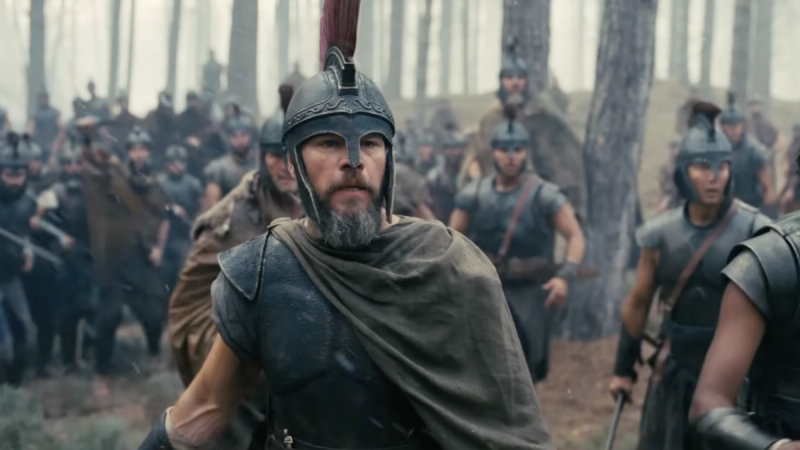
In recent years, Christians and skeptics alike seem to agree that the cynical narratives that have been on offer about religion and our Western heritage are losing steam, and so there has been a keen interest in the recent adaption of The Odyssey by Christopher Nolan. Some laud Nolan for his treatment of the Bronze Age poem and for his help driving four different translations to the bestseller list on Amazon. Others, however, find Nolan’s adaptation to be symptomatic of our secular age, rather than a respite from late modernity.
Paul Anleitner and The Gospel Coalition’s Brett McCracken have written critical pieces of the film. In their view, Nolan subverts the mythical and enchanted world of The Odyssey and turns it into a postmodern deconstruction story. Nolan, in this view, is unable (or unwilling) to break out of his materialistic worldview and allow the myths of the ancient world to earnestly speak on their own terms. Thus, Nolan’s Odysseus is stuck within Taylor’s imminent frame, endlessly caught in inner self-reflection, guilt, and doubt.
While I do not mean to be a stereotypical millennial Nolan bro, in this case I will don the cape and cowl. Anleitner, McCracken, and those making similar criticisms are incredibly thoughtful and apt commentators. They’re certainly more versed in film and myth than I am. But on this topic in particular, I fear their criticisms are based on misconceptions and faulty premises about the ancient world.
I do not mean to defend everything in Nolan’s Odyssey, but I will defend the film from the criticism that it is a kind of postmodern subversion of Homer’s poem.
To do this, I am going to compare these criticisms with some of Michael Horton’s work and his trilogy on the history of the Divine Self, especially volume 1, Shaman and Sage: The Roots of “Spiritual but Not Religious” in Antiquity, where Horton delves into the spiritual landscape of the Bronze Age.
Homer’s Gods
In their reviews, Anleitner and McCracken suggest that one of the ways Nolan naturalizes The Odyssey is by making the gods predominantly appear off-screen; instead of personal characters, the film depicts Poseidon’s and Zeus’s wrath through natural storms and weather, thus minimizing their divine intervention in the story.
McCracken writes, “It’s not that Nolan dislikes Greek mythology. He seems to appreciate it as a beautiful story that helped build Western civilization. But Damon’s version of Odysseus doesn’t particularly need the gods. He often feels skeptical of them (‘Why can’t God speak in ways we understand?’) and puts faith more in himself than in deities. When he tells his crew that ‘the gods help those who help themselves,’ or that he’ll ‘defy the gods,’ he basically admits his belief in human agency as a more powerful force than divine sovereignty.”
The criticism depicts a palpable tension between human activity and an enchanted view of the world where there is frequent and personal divine intervention.
First, it is worth noting that this creative decision from Nolan seems less ideological and more practical. In an interview, Nolan said he thought about depicting the gods in a more “overt fashion” but decided not to. “For me, having these remote gods with chess pieces or whatever, all the things you’ve seen in the past, felt alienating…. It’s not so much about trying to be realistic; it’s just trying to see the gods the way these characters would have seen them.”
This isn’t the only time Nolan does this, but I think he has stumbled into depicting a more accurate view of Bronze Age spirituality than we realize. In other words, the supposed tension between human agency and divine intervention isn’t there.
A helpful category to understand this is what some scholars of antiquity call a “locative” view of the self. Michael Horton summarizes this Bronze Age view, saying, “The individual agency of mortals is submerged in the drama of the gods who are themselves subject ultimately to Fate.”
As Brune Snell observes, ‘In Homer the outstanding feats of man are said to spring, not from his individual character or from his special gifts, but from the divine force which flows through him. To formulate this more pointedly: There are personal fates, but no personal achievements.’ What is clear implicitly is that the self is miserable and practically nonexistent when it leaves the locative, social, embedded world that, for all its woes and limits, is not without its joys whenever a god in a favorable mood puts wind in its sail. It is no wonder that the afterlife was virtually ignored in favor of whatever prosperity one could enjoy here and now. It was through the endurance of the family line and the city that one’s existence continued. (p. 50, Shaman and Sage)
As Horton and others painstakingly detail, the concept of the self is entirely different from our modern conception. There is no self away from the public cult of the king and the city. Humans are not seen as having agency at all. They are puppets of the gods. What’s more, the gods themselves are also governed by eternal principles of Fate. In the Bronze Age, celestial gods, earthly cities, kings, and families are all nested within each other like Russian dolls.
Nolan’s omission of Poseidon and Zeus as personable characters, then, does not undermine the spiritual dimension of Homer. The gods were in every human action, battle, and storm. One might disagree with the creative decision, but as Nolan said, “It’s not so much about trying to be realistic; it’s just trying to see the gods the way these characters would have seen them.”
If this is the case, one might be wondering, does this not make the film’s marketing tagline, “Defy the gods,” all the more subversive? I think the opposite is true.
As Horton demonstrates, The Odyssey can be included in what scholars describe as “The-Hero-that-failed” stories, where we see the consequences of what happens when humans try to transgress the law and public order of the polis.
In all these myths of the epic age, the human being is a survivor. One can imagine the cautious grin of the narrator concluding the Sumerian epic Atrahasis, ‘How we sent the Flood. But a man survived the catastrophe.’ Survival is the most for which one can hope as a mortal, being part of a race that transgresses boundaries that the gods have set in place. Heroes strive for godlike immortality through reputation. Very rarely a mortal (almost always fathered by Zeus) is raised by Zeus to Olympian honors. For the most part, however, they fail. That is the point. It is good and proper for human beings to accept their fate. (pp. 34–35, Shaman and Sage)
Across the epic literature—Mesopotamian, Rigvedic, Greek, and Egyptian—the ‘Hero-That-Failed’ and humans in general are almost passive instruments. This is apparent especially in the writings of Homer. The Trojan War was first sparked by petty jealousy among Aphrodite, Hera, and Athena about who is the most beautiful. As the vain dispute widens, the strife among the gods plays itself out on the ground through the bitter slaughter of human beings.… In short, the epic narrative is consistent with the view of human beings as pawns of the gods, formed to relieve their labors and provide their honors. Humans can only seek to placate and manipulate the gods by rituals, in contrast with the Genesis account of humans, male and female, as God's image and likeness, and endowed with royal authority. (p. 38, Shaman and Sage)
Homer’s myths were not only meant to be received in a literary sense, as if they were primarily meant to convey universal truths of the human experience in the family, nostos, and the righteous rule of a noble king.
From a literary standpoint, this is no doubt true. But Homer’s epics also reinforced the foundation for all of ethics, theology, civics, and much more in the Bronze Age. Depicting Odysseus defying the gods and dealing with the consequences was Homer’s way of supporting the public religion and aristocracy.
Homer’s spirituality was centered on outward rites that had to be publicly and perfectly performed. These rites "represented the technology that preserved the alignment between the cosmic order above and its civic microcosm below. [Bronze Age religion] was concerned primarily with the well-being of the polis over the individual, ritual over doctrine and morality, and this life over the next" (pp. 42–43, Shaman and Sage).
Bronze Age spirituality was about civil maintenance first before anything else.
And Nolan’s film depicts this reasonably well. “Defying the gods” is a problem only insofar as it is a transgression of public laws and rituals that maintain civic order, not because it demonstrates human doubt in an "enchanted" view of the world.
Nolan’s Odysseus, then, learns the same lesson as Homer’s Odysseus. If you defy the gods and your station, you will bring unnecessary turmoil and pain on yourself and everyone around you. The best way to honor the gods and divine providence is to adhere to the laws of the cult, such as xenia (more on this later).
By describing Homer’s myths predominantly in literary and spiritual terms instead of civic ones, Anleitner misses this point and unduly criticizes Nolan’s adaptation and Odysseus as being “postmodern” and a “deconstructing-from-my-religion agnostic.”
But if Nolan truly wanted to subvert and deconstruct The Odyssey, he might have desecrated its civic rituals and customs and depicted them as oppressive rather than salutary. In fact, when later Greek philosophers sought to criticize Homer and his epics, this is exactly what they did.
Nolan Supports Homer
Homer and The Odyssey are often equated with the “Dark Ages” of ancient Greece. Indeed, the very epics being debated now were being debated by Xenophanes, Heraclitus, Hecataeus, and Pindar, all of whom criticized Homer’s gods for being shameful, immoral, and foolish.
Myth and logos during this time began to be reclassified. As Homer’s epics came to be read more allegorically, spirituality and religion moved from respecting social and public rituals to more shamanic practices that focused on inward, individual, and private union that eventually led to a more philosophical view of religion.
I’m not saying that Nolan is aware of and influenced by these arcane details. My point is that Homer has been subverted for millennia, and this subversion looked nothing like Nolan’s adaptation.
While some claim that Nolan’s Odysseus is wracked by modern guilt and other anachronistic sensibilities, even these seem to stumble upon an accurate depiction of the Bronze Age.
During the transmission of The Odyssey, many existential plights emerged, accompanied by a sense that the bounded locative world and its public laws and rituals were being disrupted. And it’s within this frame that Nolan’s Odysseus begins his doubt and self-examination.
It’s not that guilt didn’t exist in a locative environment; it did. But it was corporate rather than individualistic. Guilt was seen as a contagious disease (miasma) that plagued a city. As Horton notes,
In the sixth and fifth centuries, purification from bloodguilt (murder) also becomes an urgent matter. Diseases required ritual purification because they were bad omens or manifestations of curses that showed society had somehow become misaligned with the cosmic order. Such diseases could spread to the community or demonstrate visibly the displeasure of the gods toward the whole city. (p. 43, Shaman and Sage)
One of the ways you cleansed a clan or city from the social miasma was to bring in magician-shamans, such as Empedocles, to do various cleansing rituals to satisfy the judgment and displeasure of the gods. And, lo and behold, one of the rituals often used in the Bronze Age to cleanse social guilt involved none other than a scapegoat: “Even certain days were impure and required ceremonial cleansing. Presided over by Zeus Katharsios, lustrations involved a ritual sacrifice of birds, bulls, or sometimes a human scapegoat as "medicine" (pharmakos) on behalf of a whole town or city.” (p. 46, Shaman and Sage)
Once again, I’m not saying that Nolan is aware of all these details, but his turning Odysseus into a human scapegoat to cleanse his society of its bloodguilt is entirely in keeping with Homer and the Bronze Age.
The main reason I don’t think Nolan is trying to subvert this story is because of his treatment of “Zeus’s law” (xenia). Rather than some notion to burn all the systems and institutions of his world down for a utopian ideal, keeping Zeus’s law remains salient in the minds of Nolan’s characters. Odysseus is guilty of breaking the law many times over, but he has to break it one last time by killing the suitors who are “dependent” on his family’s hospitality. Nolan resolves this dilemma not by disregarding the law, like an antinomian, but in satisfying what the law demands with a scapegoat.
Odysseus becomes the sacrifice, Telemachus becomes the king of Ithaca, and in some sense, they are all cleansed.
This is not the only time Nolan has used René Girard’s insights on mimetic theory to resolve his films. Batman becomes the scapegoat in The Dark Knight, and J. Robert Oppenheimer becomes the scapegoat in Oppenheimer. It is telling that when Nolan looks at the depravity of human bloodlust, the most imaginative thing he can conceive to break the self-imitating cycle of violence is a scapegoat figure.
Instead of disregarding the laws and civic rituals of his characters, Nolan looks for resolution and salvation in their fulfillment. And I think if you’re caught up trying to see if Nolan’s world is enchanted or disenchanted, or if he is embracing myth with sincerity or forthrightly renouncing postmodern cynicism, you will miss this point.
Perhaps Nolan’s Odyssey is not the film cultural apologists hoped it would be, but that might not be a bad thing. In their reviews of the film, Paul Anleitner and Brett McCracken filter Nolan’s work through a litany of popularized terms (“deconstruction,” “disenchantment,” "imminent frame,” “psychological therapy culture,” “meaning crisis,” etc.), and with all due respect, I think a liberal use of these buzzwords actually limits our imagination and ability to review art and culture for what it is.
In spite of some of the film’s modern anachronisms, because Nolan pays such respect to the external laws and civics of The Odyssey, I believe his adaptation is much more conservative and supportive of Homer than critics are giving him credit for.
But I suspect that in order to assess whether The Odyssey is a good film with a “good message,” we will need to leave popular terms and buzzwords at the door of the theater.
Footnotes
Odysseus tells Teiresias, ‘my life runs on then as the gods have spun it’ (Od. 11.158). It is the gods who closed his eyes ‘under slow drops of sleep’ and ‘the mind of Zeus beyond the stormcloud stirred him’ (Od. 12.434; 24.185). Not only Diomedes's courage and strength but Achilles’s foolish fury is attributed to a god: “Hard, ruthless man,” Ajax reproves, "the gods have planted a cruel, relentless fury in your chest!" Diomedes gives up on Achilles's reckless self-will, knowing that he will fight again "whenever a god fires his blood" (IL. 9.771, 778–779, 857–858). "Surely a goddess moved her to adultery," Penelope judges concerning Helen (Od. 23.250). The heroes are spitting images of the god who controls their behavior at any given point, whether noble or vicious. Like the gods, they live by the code of warriors seeking honor and glory, yet they are mortals. (p. 38, Shaman and Sage)
Back